Transformationexperiment "MoSt wanted" (Student mobility)

In the “MoSt wanted – Student mobility” transformation experiment, the Chair of Quantitative Methods of Empirical Social Research, in collaboration with the WueLAB Sustainability Laboratory, is studying the mobility of students at JMU Würzburg.
Relevance: Knowledge about (spatial) mobility is of particular importance to universities. A large portion of CO2 emissions at institutions of higher education is generated by travel to and within the campus. However, little is currently known about the highly complex mobility patterns of JMU students, which cannot be deduced f.e. from their registered addresses or course enrollment figures. We know from the Würzburg 2023 Mobility Survey—which tracked the mobility of Würzburg’s resident population on a specific date—that students, for example, make more trips per day than other demographic groups. They also use bicycles and public transportation more frequently than other groups. What we cannot yet say, however, is how the mobility of JMU students without a registered address in Würzburg is structured, how mobility differs between the summer and winter semesters; what patterns mobility follows over the course of the semester; how the lecture-free period differs from the lecture period; and how more sustainable mobility among JMU students can be supported based on evidence. The MoSt wanted transformation experiment aims to answer these questions.
Objective: The transformation experiment aims to create a reliable database on the complex mobility patterns of students throughout the year, focusing not only on their mobility behavior but also on their wishes and needs.
Approach: To capture student mobility, we are designing a new, innovative survey methodology that addresses the various challenges involved in obtaining reliable measurements (high response rate, fluctuations over the course of the year, etc.). We will therefore combine QR code-based online surveys in randomly selected in-person courses with student attendance counts in these courses throughout the semester.
Data analysis and archiving: The data will be handled in accordance with the FAIR principles (“findable,” “accessible,” “interoperable,” “reusable”) and therefore in a sustainable way. This means the data can be used not only for evidence-based traffic management and campus planning, but also for scientific mobility research.
Planned duration: 10/2026–09/2028
You can learn more about this and other transformation experiments on the WueLAB website.
Once published, you will find here an overview of the key findings of the study, as well as the option to download our report and methodology documentation.
You will soon find the following here once they are published:
- Privacy and Data Use Policy
- Documentation of Results and Methods
- Questionnaire
The data is analyzed using statistical methods and aggregated into groups. No conclusions about individual persons are drawn from the data.
We handle your data with care and comply with current data protection guidelines in every respect.
You will soon be able to download the statement on data protection and data use from the download section.
Contact
You can reach us via the following methods:
- By email: jmu-most@uni-wuerzburg.de
- By phone: 0931/31-83643
- By mail:
“Student Mobility” Transformation Experiment
c/o Chair of Quantitative Methods of Empirical Social Research
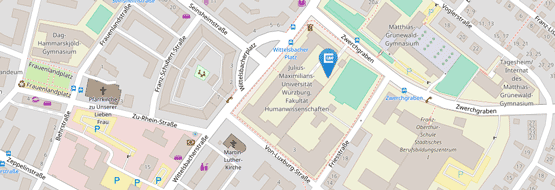
Wittelsbacherplatz 1
97074 Würzburg
Organization
The “Student Mobility” Transformation Experiment is a project of the Chair of Quantitative Methods of Empirical Social Research and the WueLAB Sustainability Lab at Julius Maximilian University of Würzburg. The project is led by Prof. Dr. Christiane Gross. Micha Pastuschka is the project coordinator.
Planned duration
10/2026–09/2028
The data from “MoSt wanted” will be made available for long-term access at the end of the project in accordance with the FAIR principles (“findable,” “accessible,” “interoperable,” “reusable”).
Once the data has been processed and de facto anonymized, you will find a link to the data repository here.