Dr. Carolin Zieringer
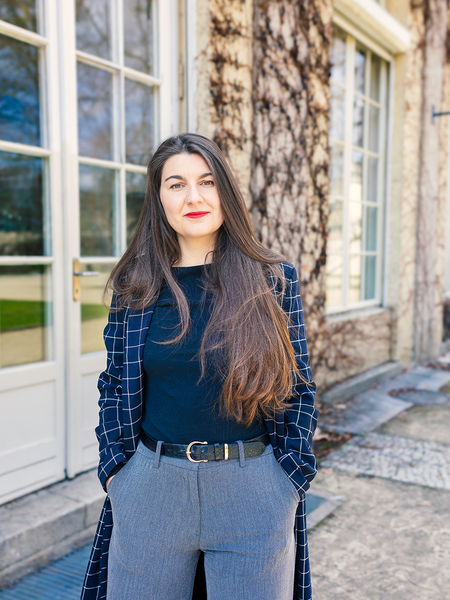
Dr. Carolin Zieringer
Division of Political Theory
Institute of Political Science and Sociology
Julius-Maximilians-Universität Würzburg
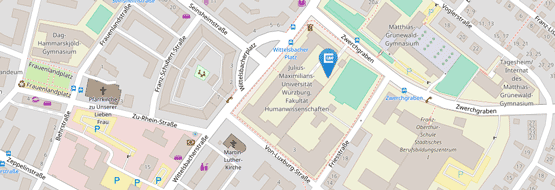
Wittelsbacherplatz 1
97074 Würzburg
Germany
Room 00.108
Telephone: +49 (0)931 / 31 84788
E-mail: carolin.zieringer@uni-wuerzburg.de
Office Hours for the winterterm 26/27: Monday from 4:00 p.m. to 6:00 p.m.; registration by email is required.
Students who have previously taken at least one seminar with Carolin Zieringer may request supervision for their thesis (BA, MA), provided that it falls within the field of political theory. When requesting supervision, you must include a brief research proposal (topic, planned argument/thesis/research question, initial contextualization within the (research) discourse, rough timeline, and initial bibliography). This will be the basis of an in-person meeting to discuss how to proceed.
Carolin Zieringer is a political scientist. She conducts research and actively teaches in the field of political theory. From 2022 to 2025, she completed her Ph.D. as a research fellow at the DFG Research Training Group 2686 “Contradiction Studies”, supverised by Prof. Martin Nonhoff (Bremen) and Prof. Brigitte Bargetz (Linz) with the project “Caring for Contradiction” [Für Widerspruch sorgen]. As part of this work, she was a visiting fellow hosted by Prof. Bonnie Honig at Brown University in Providence (USA). Her master’s thesis was awarded the Pat Caplan Award of Goldsmiths College for best thesis in anthropology, and her dissertation was awarded the Bremen Academic Prize [Bremer Studienpreis] for best dissertation in the social sciences.
She studied Political Science and Social and Cultural Anthropology (B.A., University of Bremen, Universidad de Salamanca), Anthropology and Cultural Studies (M.A., Goldsmiths College, University of London), and Political Theory (M.A., Goethe University Frankfurt). In addition, Carolin co-curated and managed the queer-feminist festival “Nocturnal Unrest” for theory, performance, and radical flâneuserie in 2021 at the artists' house Mousonturm, Frankfurt. This background influences her academic work in that it integrates theory with artistic and practical perspectives, as well as participatory and inclusive approaches.
Carolin’s work combines (radical) democratic theory, intersectional feminist theories, critiques of power/domination, and disability studies. She is particularly interested in questions surrounding corporeality and relationality, subjectivity/subjectification and gender, sovereignty, and care. She practices a normative political theory that understands itself as "Demokratiewissenschaft" and, within this framework, is committed to the critical production of knowledge with trans- and interdisciplinary connections. This scholarly approach is motivated by the search for answers to contemporary political challenges, such as authoritarianisation and social inequality. Carolin’s approach to the phenomena and questions under investigation is shaped by a critical approach to corporeality: “body politics,” “body politic,” and “political bodies” offer diverse, systematizing gateways into political theory and the history of ideas.
Thematically, her research focuses on questions of democratic inclusion and exclusion as well as democratic agency—specifically, how these are mediated by gender relations—and the political category of “dis/ability,” which is examined in the habilitation project: In the contemporary context of international processes of authoritarianisation, approaches grounded in democratic theory have long emphasized the role that the hierarchization of difference plays in these politics. It has been convincingly argued that existing classist or racist inequalities make liberal-capitalist democracies vulnerable to crises (e.g., the “care crisis”) and to authoritarian-populist promises. Little attention, however, is paid to the co-constitutive category of “Dis/Ability” (non-/disability), even though its hegemonic appropriation can be identified as one of the main causes of social hierarchies. This marginalization stands in contrast to the fact that the governance, control, and emancipation of all human bodies are mediated through the historically contingent, highly complex category of “disability.” This approach is well-suited to highlighting democratic deficits that only appear to affect people with disabilities exclusively; however, their (partial or full) exclusion from the democratic process serves as an indicator of structural democratic (and also democratic science) deficits. Furthermore, linking research to ethnographic case studies offers the opportunity for in-depth reflection on political-theoretical methodology and epistemology.
BA: Authoritarianism and (Radical) Democracy: Defining Their Relationship in the 21st Century
BA: Who Cares? On the Relationship Between Democracy and Care
BA: Foundations of Feminist (Social) Theory
BA: Reading Course: “The Dialectic of Enlightenment”
MA: Normative Political Theory