
Open Conference of the ‘International Relations’ Section of the German Political Science Association (DVPW) · 21 to 23 September 2026

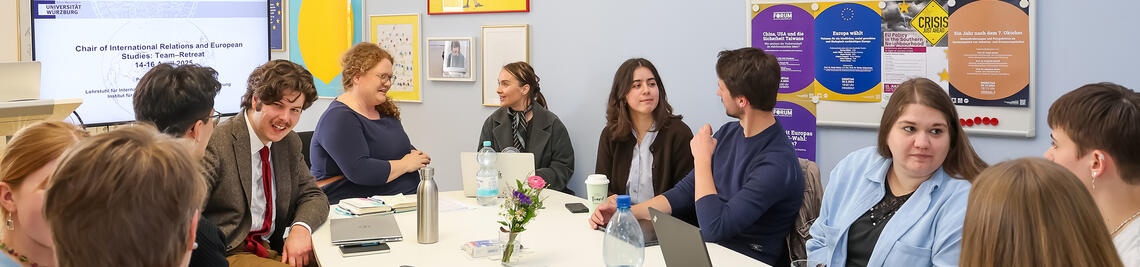
From 21 to 23 September 2026, the Open Conference of the ‘International Relations’ Section of the German Political Science Association (DVPW) took place at Julius Maximilian University of Würzburg, Germany. The conference brought together scholars from various fields of International Relations and provided a forum for exchange, discussion, and networking.
Galerie


International Order, Academic Freedom and Academic Careers
The conference focused in particular on three thematic areas that currently concern the German International Relations community:
- Global autocratisation and international order: What consequences does increasing autocratisation have for global institutions and for the international community’s capacity to address shared challenges such as climate change, migration and conflict?
- Academic freedom: How can academic freedom and the conditions for independent research be protected in the face of autocratisation and societal polarisation?
- Academic careers: What prospects do early-career researchers have in the face of increasingly constrained resources for academia and research?
These three themes shaped the discussions throughout the conference and provided numerous points of departure for scholarly and collegial exchange. Across a total of 16 roundtables and 50 panels, other key topics in International Relations were also presented, reflected upon and critically discussed. The invited students likewise made an important contribution by bringing their perspectives into the discussions.
Two Evening Panels on Current Challenges
Two public panel discussions were particular highlights of the programme.
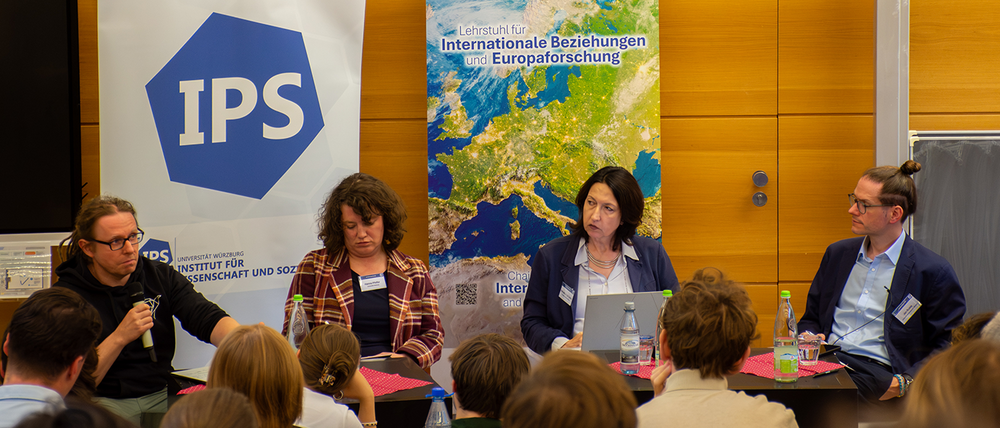
Under the title “IR Research in Turbulent Times: How Free Is It (Still)?” discussed Dr. Jannis Julien Grimm, Dr. Lars Lott, Prof. Dr. Markus Ludwigs, PD Dr. Janne Mende and Dr. Eirliani Abdul Rahman the issue of academic freedom in politically and socially challenging times in the Audimax auditorium of the New University. The discussion was chaired by Prof. Dr. Sonja Grimm.
The second panel focused on “The Gaza War and (German) IR”. The panel featured Dr. Peter Lintl, Dr. Hanna Pfeifer and Prof. Dr. Raffaella A. Del Sarto, and was chaired by Dr. Jan Busse.
ZIB Paper Award for Cornelia Baciu
The ZIB Paper Award for Early Career Scholars was awared during the conference. We warmly congratulate Dr. Cornelia Baciu on receiving this distinction.
Our thanks go to the ZIB team led by Prof. Dr. Bernhard Stahl and Dr. Jan Busse for their support and collaboration, as well as to the jury members for making the selection.
Thanks to Everyone Involved
A conference of this scale is only possible through the combined efforts of many people. Our particular thanks go to the Executive Board of the International Relations Section – Dr. Dennis Redeker, Prof. Dr. Markus Lederer and Dr. Melanie Morisse – for the joint preparation and organisation of the conference.
We thank all colleagues in attendance, and especially the chairs and discussants, for their committed participation in and contribution to all roundtables and panels.
We would also like to thank the University of Würzburg, the Faculty of Human Sciences, in particular its facilities services team, the Institute of Political Science and Sociology (IPS), as well as the Press Office of the University of Würzburg for their support.
We thank the Executive Office of the German Political Science Association (DVPW), in particular Dr. Vera van Hüllen, for its professional support in organising the conference.
We also thank the Bavarian Research Alliance for Peace, Conflict and Security Studies FOKS, the publishers Nomos, Springer, Wochenschau Verlag, Campus, Duncker & Humblot and LIT, as well as our service providers: the Pavillon catering service, Staatlicher Hofkeller Würzburg, the music trio led by Peter Pfriem, and photographer Rudi Merkl, for supporting the conference.
Finally, a special thank you goes to the entire organising team: Tabea Yilu, Philipp Berg, Emely Bischof, Maya van der Linden, Redona Tafaj, Dr. Elena Dück, Dr. Philipp Gieg, Noemi Albrecht, Carolin Gutmüller, Mara Nelegatti, Antonia Jordan and Alexander Gerner.
The 2026 Open Conference of the International Relations Section of the German Political Science Association (DVPW) created space for discussing current challenges and strengthened scholarly exchange within the community. The discussions will continue, at the latest, at the 2027 DVPW Congress. Members of the International Relations Section will also meet for a members’ meeting as part of the Congress. We look forward to it!
Prof. Dr. Sonja Grimm on behalf of the entire organising team

How free can science be in an era of autocratisation, social polarisation and increasing attacks on researchers? A panel discussion held as part of the IR Section Conference in Würzburg addressed current challenges to academic freedom – ranging from international developments and specific experiences to institutional safeguards.
What is the state of academic freedom in times of autocratisation, social polarisation and increasing hostility towards researchers? This question was the focus of the public panel discussion ‘IB Research in Turbulent Times: How Free Is It (Still)?’, which took place as part of the DVPW’s IB Section Open Conference in the Audimax of Julius Maximilian University of Würzburg on 21 September 2026.
The discussion was moderated by Prof. Dr Sonja Grimm, holder of the Chair of International Relations and European Studies at the Julius Maximilian University of Würzburg, member of the Executive Board of the International Relations Section of the DVPW and host of the conference. The panel brought together a range of perspectives on academic freedom: from empirical research, from university practice, from the perspective of early-career researchers, and from international contexts.
Academic freedom under pressure
The event began with brief presentations by the five panellists. Dr Lars Lott, project coordinator of the Academic Freedom Index at Friedrich-Alexander University Erlangen-Nuremberg, presented key findings and insights from the Index regarding global trends in academic freedom.
This was followed by a presentation from PD Dr Janne Mende of the Max Planck Institute for Foreign Public Law and International Law in Heidelberg. In her capacity as a representative of the DVPW Executive Board, she reported on the results of the DVPW member survey regarding experiences of hostility and threats. This also brought the specific experiences of academics within the German political science community into focus.
Dr Jannis Julien Grimm, Director of the Radical Spaces research group at the Free University of Berlin, contributed a further perspective. He spoke about his experiences within the Berlin academic context and discussed personal impressions and challenges relating to academic freedom.
Dr Eirliani Abdul Rahman, co-founder and co-director of the Global Responsible Tech Lab (GRTL) and principal investigator at the Mannheim Centre for European Social Research (MZES) at the University of Mannheim, contributed to the discussion by sharing experiences from the US context in academia and on social media.
Prof. Dr Markus Ludwigs from Julius Maximilian University of Würzburg provided an institutional perspective on safeguarding academic freedom. As chair of the working group ‘Code of Academic Freedom at JMU’, he outlined the origins, objectives and initial experiences with the Würzburg Code.
The individual contributions were taken up by the chair, Prof. Dr Sonja Grimm, who explored them in greater depth through follow-up questions.
How much freedom can academics afford?
The subsequent moderated debate centred on the specific conditions of academic freedom. A key focus was on the situation of early-career scholars: how much academic freedom can early-career academics afford when their professional future is shaped by fixed-term contracts, institutional dependencies and international power dynamics?
Furthermore, the discussion turned to the limits of academic cooperation. The focus here was on the tension between international academic exchange and collaboration with institutions and actors from repressive political contexts. Possible links to human rights violations or to knowledge that could be used for military purposes also raise questions about the responsibility of researchers and universities.
Finally, attention turned to the future of academic freedom. Digitalisation, surveillance and geopolitical fragmentation are transforming the conditions of academic work and international cooperation. This also raises the question of whether existing safeguards are sufficient and what role international rules and institutional codes of conduct might play in the future.
Academic freedom as a shared responsibility
The roundtable made it clear that academic freedom is not merely an abstract institutional or legal issue. It concerns specific working conditions, international collaboration and day-to-day academic life, as well as how to deal with hostility and threats from both within and outside the academic community.
By combining empirical findings, personal accounts and institutional perspectives, the panel discussion provided a forum for bringing together the various dimensions of these challenges and for jointly considering possible courses of action.
Following the panel discussion, the audience had the opportunity to ask their own questions and continue the discussion with the panellists. The evening drew to a close with a reception in the atrium of the Neue Universität.
Panel: Dr Lars Lott (Friedrich-Alexander University of Erlangen-Nuremberg), PD Dr Janne Mende (Max Planck Institute, Heidelberg / DVPW), Dr Jannis Julien Grimm (Free University of Berlin), Dr Eirliani Abdul Rahman (Global Responsible Tech Lab / MZES, University of Mannheim) and Prof. Dr Markus Ludwigs (Julius Maximilian University of Würzburg).
Chair: Prof. Dr Sonja Grimm (Julius Maximilian University of Würzburg).
How is the field of International Relations addressing the Gaza War—and what specific challenges does this pose for the German academic community? These questions were the focus of the ZIB roundtable “The Gaza War and (German) International Relations” on Tuesday evening at the 2026 International Relations Section Open Conference in Würzburg.
Moderated by ZIB co-editor Jan Busse (University of the German Armed Forces, Munich), the discussion featured Dr. Hanna Pfeifer (Institute for Peace Research and Security Policy at the University of Hamburg), Prof. Dr. Raffaella A. Del Sarto (European University Institute, Florence), and Dr. Peter Lintl (Foundation on Science and Politics, Berlin) discussed the academic approach to the Gaza War and the conditions under which research and scholarly debates on Gaza are currently taking place.
The focus was not solely on analyzing the conflict itself. Rather, a meta-analysis also examined IR research and its role in society. Given Germany’s history, the German academic and social discourse was found to possess a unique dynamic.
Among other things, it became clear that scholarly engagement with Gaza does not take place in isolation from its social context. The experiences of scholars facing hostility in connection with their research were addressed. There was also discussion of how academia can generally keep the space for debate open on controversial and complex topics. In this context, it was pointed out that academia can hardly live up to the expectations of politics and the media. It was also noted as problematic that the public debate focuses on a dispute over terminology, even though it is more the responsibility of academic disciplines such as international law or international relations to define terms and feed them into the public debate. In this specific case, this was not achieved at all. During the discussion, a member of the audience pointed out that, in addition to participating in a broad public debate, there is also the option of addressing relevant topics within the framework of university teaching.
The roundtable aligned with the ZIB’s overarching goal of engaging in controversies and discussions in a scholarly manner and fostering dialogue between different perspectives within the discipline.
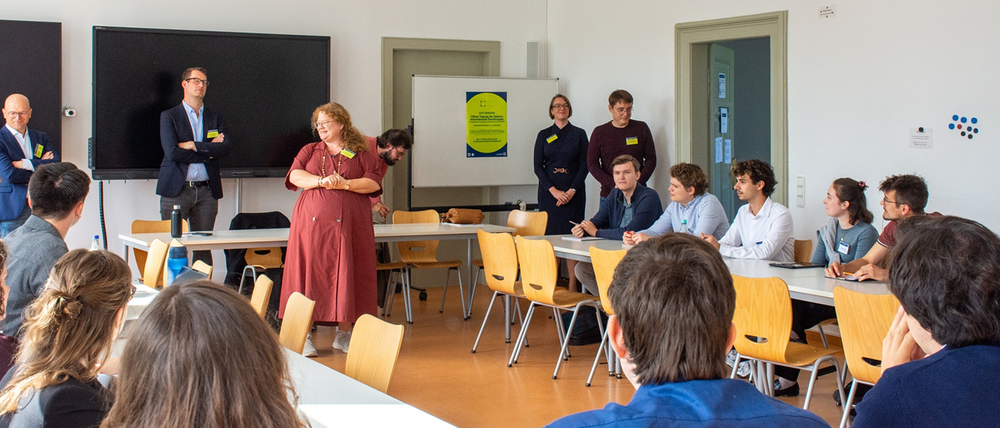
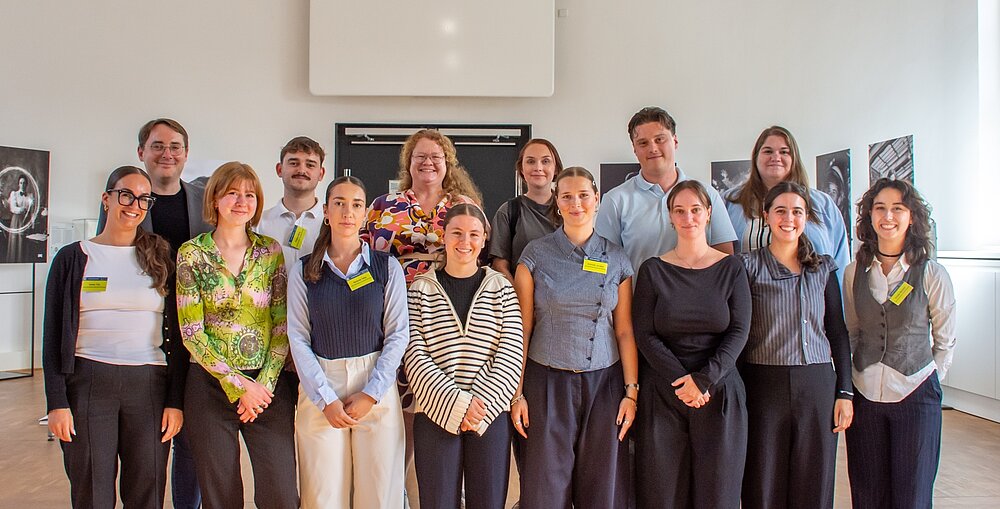
For the first time, undergraduate and graduate students were invited to actively participate and shape the 2026 IR Section Open Conference. Thirty-four students were selected for this purpose following an application process. This created a new format designed to foster exchange between students and scholars at various stages of their careers and to give students direct insight into research practices and the day-to-day work of scholars in the field of International Relations.
The opportunity to participate generated a great deal of interest. During the conference, the invited students were able to learn about current research, take part in academic discussions, and engage in conversation with scholars at various stages of their careers. In this way, the conference not only offered insights into current debates in international relations but also provided an opportunity to establish contacts within the academic community.
Discussion on Academia and Careers
Even before the conference officially began, the students were welcomed by the IR Section’s Executive Board— Prof. Dr. Markus Lederer, Prof. Dr. Sonja Grimm, and Dr. Dennis Redeker—as well as ECIB Spokesperson Stefan Maukner and the two Würzburg postdocs, Dr. Elena Dück and Dr. Philipp Gieg.
The meeting focused on questions regarding the proceedings and organization of academic conferences, as well as career paths and prospects in the field of International Relations. The students had the opportunity to ask their questions directly to the members of the Board of the IB Section and to exchange experiences and various career paths in academia.
Involving students at all academic levels was a key priority of the conference: academic exchange should not be limited to established researchers and early-career scholars, but should begin as early as the undergraduate level.
Students as Part of the Academic Community
The participation of undergraduate and graduate students enriched the conference with additional perspectives and created new opportunities for exchange among different generations and career stages within the field of International Relations.
The new format is intended to help connect students with the academic community at an early stage, foster interest in international relations research, and provide insights into academic work and career paths.
The IR Section would like to thank all participating students for their interest and their active participation in the conference.
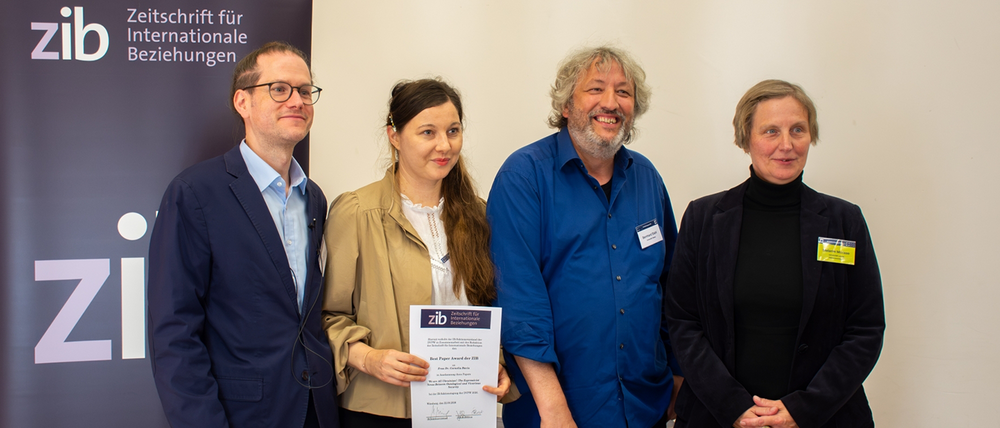
At the 2026 IB Section Conference of the German Political Science Association (DVPW) held at Julius Maximilian University of Würzburg, Dr Cornelia Baciu was awarded the ZIB Best Paper Award 2026. The award recognises outstanding academic work by researchers in the early stages of their careers and is accompanied by the opportunity to have their work published in the “Zeitschrift für Internationale Beziehungen” (ZIB).
The award was given for Baciu’s paper “‘We are All Ukrainian’: The Expressivist Nexus Between Ontological and Vicarious Security”, which was presented as part of the panel “Amid Global Transformations: Reconfiguring the EU’s Foreign Policy and External Relations”.
How is the war against Ukraine changing Europe’s understanding of security?
In her article, Cornelia Baciu examines how, since Russia’s war of aggression, Ukraine has become a source of so-called “vicarious security” for Europe. The focus is on the question of how European support for Ukraine cannot be explained solely in terms of immediate security interests, but also contributes to the stabilisation and transformation of European identity.
Theoretically, the study links concepts of ontological security with the approach of vicarious security and further develops this connection from an expressivist perspective inspired by Nietzsche. In contrast to explanations that understand vicarious security primarily as a reaction to a deficiency or as a consequence of co-presence, Baciu places the focus on processes of self-transformation and ‘becoming’.
Support for Ukraine as a process of European self-transformation
Drawing on European support and military aid for Ukraine, as well as political statements by European leaders, the study demonstrates how Europe’s growing identification with Ukraine is taking shape. Ukraine is portrayed as a “significant other”, whose survival is increasingly presented as closely linked to Europe’s own security and freedom.
Bacius’s central thesis is that this form of support is not merely compensatory. Rather, it can be understood as a productive process of European self-transformation: by supporting Ukraine, Europe is simultaneously transforming and stabilising its own understanding of identity and security.
The study thus reveals that not only political narratives, but also concrete political practices are involved in the creation of ontological security.
Theoretical and methodological contribution
The jury and the nominators particularly commended the combination of theoretical innovation and empirical analysis. A key contribution is made by the redefinition of the concept of ‘vicarious security’: vicarious security is understood not merely as a derivative reaction, but as a process through which political communities can transform themselves.
Furthermore, the work combines its theoretical argumentation with an analysis of political practices. The further development of “Practice Tracing” helps to elucidate the connection between concrete political action and processes of identity formation.
The study thus makes an original contribution to international security research whilst simultaneously opening up new perspectives on the political significance of existential crises, European solidarity and support for Ukraine.
About the recipient
Dr Cornelia Baciu is a postdoctoral researcher at Saarland University, within the Cluster for European Studies and the Europa Early-Career Research Group.
The ZIB Best Paper Award recognises an early-career researcher for a paper that combines theoretical development with an empirically grounded analysis of current issues in European foreign and security policy.
The ZIB selection jury and the Executive Board of the International Relations Section of the DVPW warmly congratulate Cornelia Baciu on this award and wish her continued success in her academic work.
Executive Committee of the IB Section at the DVPW:
- Sonja Grimm
- Markus Lederer
- Melanie Morisse
- Dennis Redeker (currently acting)
Organization team in Würzburg:
Prof. Dr. Sonja Grimm
Chair of International Relations and European Studies
Julius Maximilian University of Würzburg
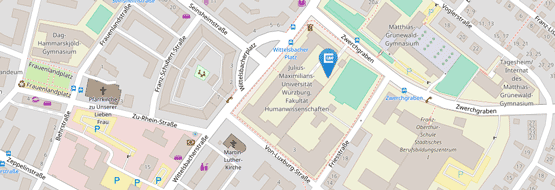
Wittelsbacherplatz 1, 97074 Würzburg, Germany
Team assistant: Tabea Yilu