Party types in South-Eastern Europe: the case of Albania and Kosovo
Party types in South-Eastern Europe: the case of Albania and Kosovo
| Date: | 06/30/2026, 4:00 PM |
| Category: | seminar |
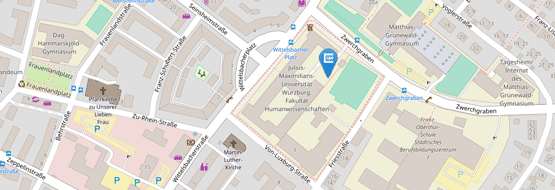
| Location: | Wittelsbacherplatz 1, 00.202 / Hybrid |
| Speaker: | Liza Beci |
This seminar discusses the results of the doctoral project of Liza Beci.
Due to the incredibly warm weather conditions, we have decided to offer this event in hybrid mode. Here is a Zoom link where you can participate online:
https://uni-wuerzburg.zoom-x.de/j/65310806785?pwd=cLZifqRgsR0GqvnXMdBUiJ3VqszrJL.1
Meeting ID: 653 1080 6785
Password: 692046
Abstract
This doctoral project compares the theoretically established political party types and their characteristics. As part of the project, the theoretical classification of party types are applied to parties in Albania an Kosova. The goal is to develop further existing research on party types theoretically and to determine their general validity for parties that have been less researched so far like those in Albania and Kosova.
Political parties play a central role in various political systems as mediators between society and the state. Accordingly, research into party types and their classification has a long history in the political research. In connection with the goal of developing universally valid party types, the further development of party type research is an indispensable tool.
This doctoral thesis therefore addresses the following research questions:
- What categories and criteria are used to determine party types in existing political science research?
- What party types are distinguished?
- What party types can be identified in Albania and Kosovo?
The doctoral project is divided methodologically. While the theoretical part is approached hermeneutically, the methodological approach to researching parties in Albania and Kosovo is based on various qualitative methods. The central qualitative methods are participant observation, qualitative interviews and qualitative content analysis.