

Profile
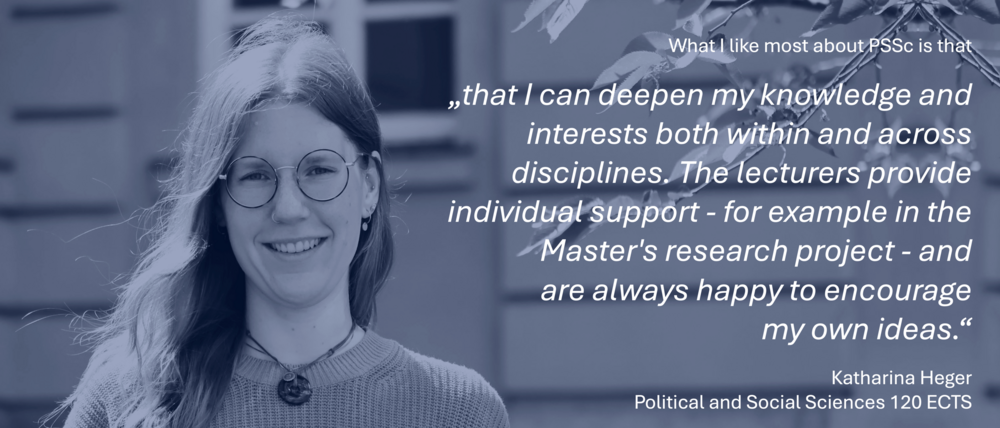
The master's program in Political and Social Sciences is a consecutive degree program for students who wish to deepen their knowledge of political science and sociology. As a research-oriented degree program, it enables students to work independently and autonomously on social science issues.
You have the option of choosing between a single-subject major master's degree (120 ECTS) and a joint-major master's degree (45 ECTS). Due to the integrative combination of the two disciplines of political science and sociology, you can prepare for a broad range of topics that will allow you to specialize by setting your own focus. You will deal with issues of Comparative Politics, International Relations, Political Theory, Sociological Theory, Applied Sociology and Methods of Qualitative Empirical Social Research, Quantitative Method of Empirical Social Research, as well as Social Sciences Sustainability Research.

Sociological Theory
Courses in this area deal with sociological approaches towards theories of international social comparison, which are discussed under keywords such as “Varieties of Capitalism” or “Multiple Modernities”. These approaches are also precursors to relatively recent considerations on a sociology of globalization phenomena and the constitution of a world society.

International Relations and European Studies
The field of “International Relations and European Studies” examines phenomena of intra- and extra-European as well as cross-border politics. In addition, students gain in-depth knowledge of the methods and theories of research in international relations and European integration, the current and future challenges of the European integration process, the shaping of global governance and dealing with the challenges of the new, multipolar world order

Methods of Quantitative Empirical Social Research
The area of quantitative methods covers the entire research process from the theoretical derivation of hypotheses, the selection of a suitable research design, data collection, recording and analysis through to the interpretation and clear presentation of the results. Students also learn how to use statistical programs such as Stata.
Political Theory
The field of political theory examines the basic structures of constitutional democracy and the Nation State in Western societies as well as their socio-economic and cultural preconditions. It also analyses transformations of Nation States and the normative aspects of the transnational order in times of globalization.

Social Sciences Sustainability Research
Students are given an overview of existing social science research approaches in the fields of political science and sociology with a focus on interdisciplinary climate and sustainability research. This is often orientated towards the Sustainable Development Goals formulated by the United Nations, such as the fight against poverty, gender equality, quality education, health and well-being. In addition, the research area teaches students the ability to structure fundamental questions and fields of research and to relate them to one another and to reflect on the importance of subject-related and interdisciplinary work.

Applied Sociology and Methods of Qualitative Empirical Social Research
In this area, students examine media and their modes of action: From a sociological point of view, what can be understood by a medium? What formative power do media develop? How do their effects become empirically visible? As a preferred object of analysis, practices of the public and the private - but also the media infrastructures themselves - are discussed and illuminated. |
Comparative Political Sciences
Comparative political science modules focus on three key topics: Students will discuss the relevance of neo-institutionalist approaches for political science analysis, the development and classification of specific policy fields and more recent approaches to democracy research. |