14.05.2025: Lecture
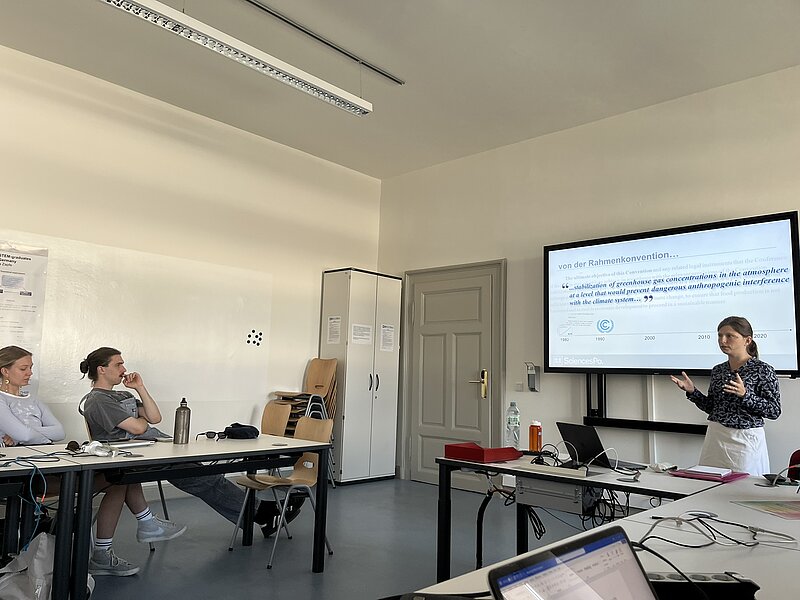
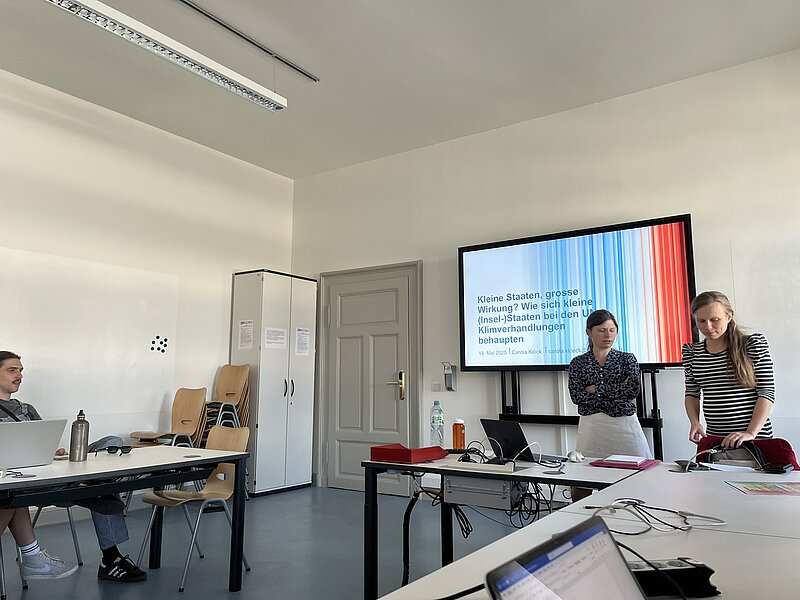
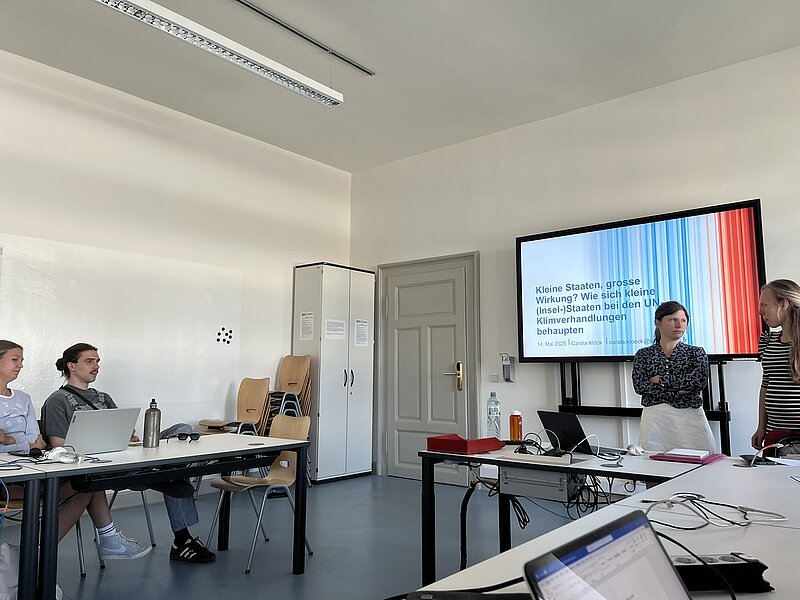
Lecture by Prof. Dr. Carola Klöck on the topic “ Small states, big impact? How small (island) states assert themselves at the UN climate negotiations.”
As part of the Forum Sustainability event series the next event for the summer term 2025 on the main topic of “Negotiating, communicating and legalizing global sustainability goals”, took place on 14 May 2025. After a short introduction by Jun-Prof. Dr. Ulrike Zeigermann and Linda Koch, Prof. Dr. Carola Klöck from SciencesPo Paris spoke on the topic “Small island states, big impact? How small (island) states assert themselves in the UN climate negotiations”.
Although small states are formally equal to large states such as Germany at the UN, they have significantly fewer resources and personnel. Some microstates even have fewer inhabitants than a medium-sized German city like Würzburg. In her presentation, Prof. Dr. Klöck explored the questions of how such states make their voices heard at the UN climate negotiations and what challenges and strategies play a role in this. Her current research project examines their presence, influence and negotiating success in international climate negotiations. Methodologically, the project is based on a mixed-methods approach that includes both quantitative and qualitative analyses.
After a historical overview of the climate negotiations – from their early beginnings through setbacks to the Paris Climate Agreement (COP21) – the focus was particularly on the role of small island states. A key problem for these small states is the small delegation size, which significantly limits their negotiating capacity. Coalitions and cooperations such as AOSIS offer an important opportunity to give them a stronger, collective voice, thus reducing negotiation complexity and increasing their negotiating power. However, significant differences and disagreements also exist within such alliances. Furthermore, the composition of delegations plays a crucial role: Experience, continuity, and the involvement of external experts influence consensus building within coalitions and the overall success of the negotiations.
International climate negotiations thus pose challenges for small (island) states, but coalitions and cooperation can help strengthen their position. Nevertheless, a differentiated view of individual states and delegations remains essential. Prof. Dr. Klöck concluded her presentation with an outlook on the next steps of her project and then led into a discussion.
The events of the Forum Sustainability will be organized in interdisciplinary cooperation with the Chair of Social Science Sustainability Research, the Chair of Public Law and International Economic Law, the Department of Political Theory and the Chair of International Relations and European Studies. The lecture could also be credited towards the GSiK Certificate in Sustainability and Global Responsibility.